LLM vs ChatGPT vs RAG: The Missing AI Explanation Every Developer Needs
Are ChatGPT and LLMs the same thing? Absolutely not. Here is a developer's guide to the real differences between raw AI models, ChatGPT's tool ecosystem, and the RAG pipelines powering modern enterprise AI.
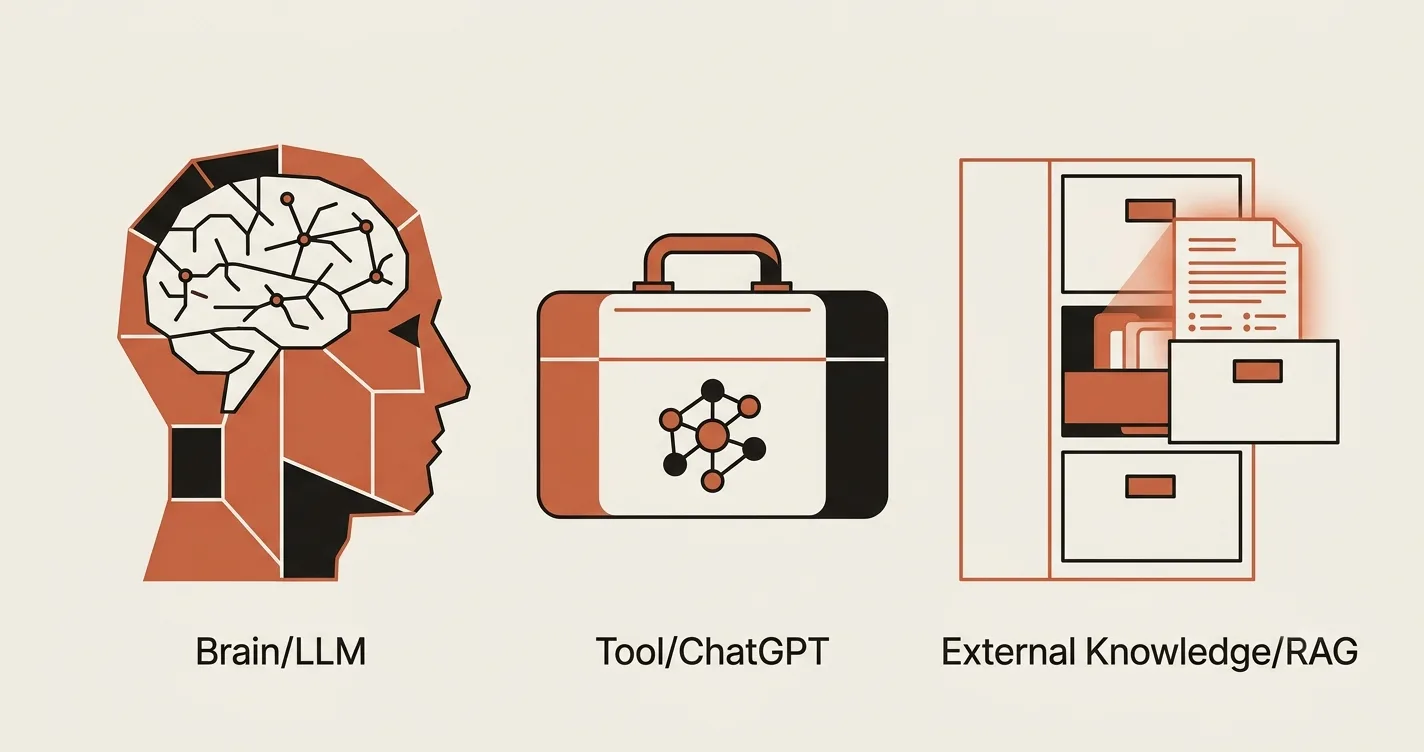
If you are currently sitting in an AI engineering training course, I want to start this article by addressing a question that I hear from students almost every single day.
"So, Teacher, is ChatGPT an LLM? And wait, what exactly is RAG? Aren't they all the same thing?"
It is an incredibly common misconception, and it is completely understandable. The AI world moves so fast that the marketing buzzwords often outpace the actual technical definitions. But here is the truth: LLM, ChatGPT, and RAG are three entirely different concepts.
If you are a developer, a student, or a professional looking to switch into AI, understanding the distinction between these three terms is the absolute foundation of everything you will build next.
Let’s break it down clearly, using my actual training sessions as a guide.
Section 1: The "Brain" – What is an LLM Model?
An LLM (Large Language Model) is a deep learning algorithm that has been trained on a massive dataset of text and code. It is a predictive engine—it learns the statistical patterns of human language and predicts what word comes next based on the input it receives.
Think of an LLM as a human brain that has been locked in a completely dark room. This brain has read every single book, article, and code repository on the internet. It has vast, encyclopedia-like knowledge of history, math, and programming. However, because it is locked in a dark room, it has zero awareness of the outside world.
- It does not know what the current weather is.
- It cannot check your email or send a tweet.
- It does not know what the date is today.
- It has absolutely zero capability to perform real-time tasks.
When you ask ChatGPT about the weather and it gives you an answer, it is not the LLM doing that. It is the platform wrapping that LLM in a tool that can search the web.
This is why when developers say "I want to integrate an LLM into my app," they mean they want to connect to a raw API endpoint like OpenAI’s gpt-4, Google's Gemini, or Meta's Llama. You are basically renting the brain for a few milliseconds.
Section 2: The "Tool" – What is ChatGPT?
This is where the confusion happens. ChatGPT is not an LLM; it is an application (a platform) that leverages an LLM.
OpenAI took the raw LLM (which they call gpt-4) and wrapped it in a software application with a beautiful interface, memory, and—crucially—tools.
Let's go back to the "brain locked in a dark room" analogy. ChatGPT is the platform that gives that brain:
- Eyes: A web browsing tool so it can search the internet for real-time information.
- Hands: A code interpreter tool so it can write, test, and execute code in real-time.
- Memory: A context window that allows you to have long, conversationally aware chats.
When you ask ChatGPT to "summarize the latest news about AI" and it goes to a website, reads an article, and summarizes it—the LLM model is only doing the summarizing part. The ChatGPT platform is doing the real-time web search.
The Critical Lesson for Developers: If you call a raw LLM API, it is a stateless brain. It cannot perform real-time tasks. If you want your application to verify a bank balance or fetch a stock price, you must build tools around the LLM. This is called "Agentic Workflow," but that is a topic for another day.
Section 3: The "External Hard Drive" – What is RAG AI?
Now, we arrive at RAG (Retrieval-Augmented Generation).
If LLMs are the brain and ChatGPT is the tool platform, RAG is the external hard drive—or the “search engine” for the AI.
The massive limitation of a traditional LLM is that it only knows what it was trained on up to a certain cutoff date (usually 2023 or 2024). If your business is a jewelry brand and you want an AI to answer questions about your specific inventory, the LLM cannot do it. It doesn’t know what "Aurethe Gold Necklace #102" is.
RAG solves this by giving the LLM access to private data at query time, without having to retrain the massive model.
Here is how a RAG pipeline works in plain English:
- Ingest: You take all your private documents (e.g., your product catalogs, your exam questions, your internal employee policies).
- Embed: You convert these documents into mathematical vectors (embeddings) and store them in a specialized database called a Vector Database (like
pgvector,Pinecone, orWeaviate). - Retrieve (The 'R' in RAG): When a user asks a question, the system searches through the Vector Database to find the exact paragraphs or documents relevant to the user's question.
- Generate (The 'G' in RAG): The system passes the user's question and the retrieved private documents into the LLM. The LLM reads the private documents, combines them with its general knowledge, and generates a highly accurate, specific answer.
Why RAG is incredibly powerful (and not obsolete): A common misconception I see online is that RAG is "dying" or being replaced by bigger models. That is completely false. RAG is the standard for enterprise AI. If you are working as an AI engineer in 2026, you will spend a significant amount of your time optimizing these specific pipelines.
I recently used this exact semantic retrieval architecture in the Chandi World luxury jewelry platform. Instead of forcing customers to type specific product names, we implemented a semantic search system that understands natural language. Customers can search, "Gold necklace for my mother," and the RAG pipeline inside the app uses vector embeddings to fetch the exact jewelry pieces that match the emotional intent of the query, which is then fed to the AI to generate the final recommendation.
Section 4: How These 3 Fit Together
To summarize it as clearly as I can for your notes:
- LLM = The Brain. A predictive text engine. Needs an API key to run.
- ChatGPT = The Platform + Tools. An application that gives the brain arms and legs so it can act on the real world.
- RAG = The External Memory. A pipeline that allows the brain to read your private documents before answering a question, ensuring it provides accurate, context-rich responses.
If you are a software engineer looking to break into AI, you do not need a Ph.D. in Neural Networks or Deep Learning to master these three concepts.
Where Do You Go From Here?
If you want to build your own RAG application from scratch, the barrier to entry is incredibly low. In fact, the core integration boils down to just a single API call.
As I tell my students: "If you can write a fetch request in JavaScript or a requests.post in Python, you can integrate an LLM. The hard part isn't the API—it's structuring your data and choosing the right vector database."
Whether you are a student wanting your first AI job, a web developer expanding your skillset, or an entrepreneur wanting to build an AI-powered product, this fundamental knowledge is your launchpad.
If you have questions about your own RAG architecture or need a second opinion on an AI project you are building, feel free to check out my engineering portfolio or reach out to me directly. I’m always happy to mentor developers transitioning into the AI space.