How to Become an AI Engineer in 2026: A Practical Roadmap for Developers
Think you need a Ph.D. in mathematics to break into AI engineering? Here is the exact roadmap I use to train regular software developers to build LLM apps, RAG pipelines, and MLOps systems.
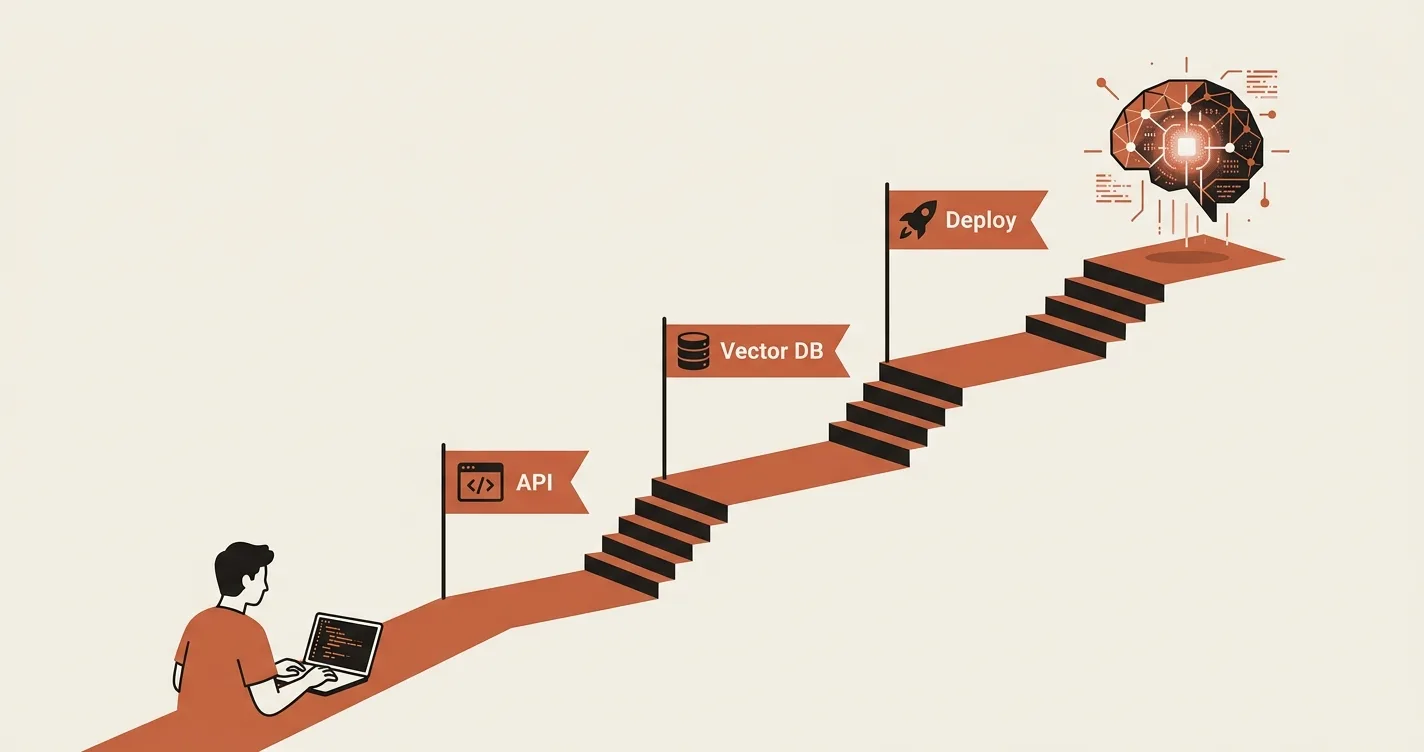
A question I hear almost daily from my students is this: "With all this AI hype, is the software engineering job going to disappear? And how do I make sure I'm not left behind?"
It is an incredibly valid fear. The industry is shifting rapidly, and the "AI Engineer" title has become one of the most sought-after roles on the market.
However, here is the truth that the media doesn't tell you: AI is not going to replace software engineers. AI is going to replace software engineers who refuse to learn how to use AI.
As someone who trains developers in AI Engineering and DevOps, I want to give you a brutally honest, highly practical roadmap to make that transition in 2026. You do not need a Ph.D. in Neural Networks to do this. You just need to shift your mindset from "Writing Code" to "Orchestrating Intelligence."
Step 1: Bust the "Math PhD" Myth
The single biggest barrier for developers entering the AI space is the belief that they need to understand calculus, linear algebra, and backpropagation to build an AI application.
That is a myth.
If you want to be a Machine Learning Researcher and invent the next GPT-5, yes, you absolutely need a Ph.D. in advanced mathematics.
But if you want to be an AI Engineer, you do not. An AI Engineer is a software engineer who knows how to wire up APIs, handle asynchronous data pipelines, choose the right vector database, and manage the deployment of LLM containers.
If you already know how to write a fetch request, how to design a database schema, and how to containerize an app with Docker, you already have 80% of the skills needed for AI Engineering. The remaining 20% is learning the new vocabulary (embeddings, tokens, context windows) and the new tools (LangChain, LlamaIndex, pgvector).
Step 2: The Core AI Engineering Curriculum
If you are looking to switch careers or upskill, here is the exact, stripped-down curriculum I recommend to my students. Don't get distracted by shiny new AI tools every week; focus on these four pillars:
- Python & API Integration: You must be comfortable with Python. Focus entirely on making
GETandPOSTrequests toOpenAI,Google Gemini, orMistral. - The "Context" Ecosystem: Learn the difference between a raw LLM, a multi-tool chatbot, and a RAG pipeline. I highly recommend reading my breakdown of LLM vs ChatGPT vs RAG if you haven't already.
- Vector Databases: Get hands-on with
pgvector(it runs inside PostgreSQL) orPinecone. Learn how to convert text into embeddings and perform semantic searches. - Prompt Engineering: Learn how to construct system prompts. The quality of your AI's output is 100% dependent on the instructions you provide in the initial prompt.
Step 3: Don't Forget the "DevOps" Side (The Untapped Advantage)
Here is a secret: the hardest part of AI in 2026 isn't the model—it's the deployment and infrastructure. Most people focus on the chatbot code, but they have no idea how to deploy a RAG application, scale it under high traffic, or manage the background queues required for embedding large datasets.
This is where your DevOps training becomes a superpower.
If you can learn how to containerize these applications using Docker, orchestrate them with Kubernetes, and set up efficient CI/CD pipelines, you become the "unicorn" of the AI industry. Companies don't just need someone to build the RAG pipeline; they desperately need someone who can keep the RAG pipeline running on a $20/month VPS without crashing.
Step 4: Build Two Real-World Projects
You cannot learn AI engineering purely from YouTube videos. You must build. I always tell my students: "Build an internal tool for your current company, or build a portfolio project that solves a real problem."
If you are looking for inspiration, look no further than the architecture I built for the Chandi World luxury jewelry platform. We implemented a high-end AI semantic search using vector embeddings to allow customers to search for jewelry using natural language (like "gold necklace for my mother") instead of rigid keywords.
Similarly, looking at the backend structured data management in my Almuneer LMS project shows you exactly how to handle complex data ingestion, which is the prerequisite for any good RAG system. Seeing how these two projects handle data retrieval versus vector retrieval is the perfect case study for your own portfolio.
Step 5: The Career Switch (Jobs & Freelance)
Once you have built your first RAG project, you are ready for the job market. AI Engineers are commanding top salaries right now because the supply of engineers who actually understand how to build production-ready AI apps is astonishingly low.
If you are already a working developer, start small. Ask your current boss if you can integrate an AI feature into the existing product. If you are a student, build a unique AI tool and showcase it on your portfolio. If you are a freelancer, start offering AI-integration services to local e-commerce businesses.
The Bottom Line
AI is not an impenetrable wall of mathematics. It is a new toolkit that developers must learn to pick up.
If you can master the fundamentals of API integration, vector databases, and containerized deployments, you will not only survive the AI wave—you will ride it all the way to a highly rewarding career.
I currently mentor developers transitioning into the AI and DevOps space, and the ones who succeed are the ones who stop hesitating and start building. If you need a second opinion on your current architecture or are wondering which AI path fits you best, feel free to check out my portfolio of projects or reach out to me directly. I’m always open to chatting with developers looking to take the next step.