Technical SEO for Laravel Developers: How to Build Marketing Pages That Actually Rank in 2026
Are your Laravel marketing pages failing to get clicks? Discover the exact technical SEO framework for Laravel developers, covering Core Web Vitals and E-E-A-T. Rank in the top 10 in 2026!
Why Your Laravel SEO Pages Get Impressions But No Clicks (And How to Fix It)
I need to make a confession.
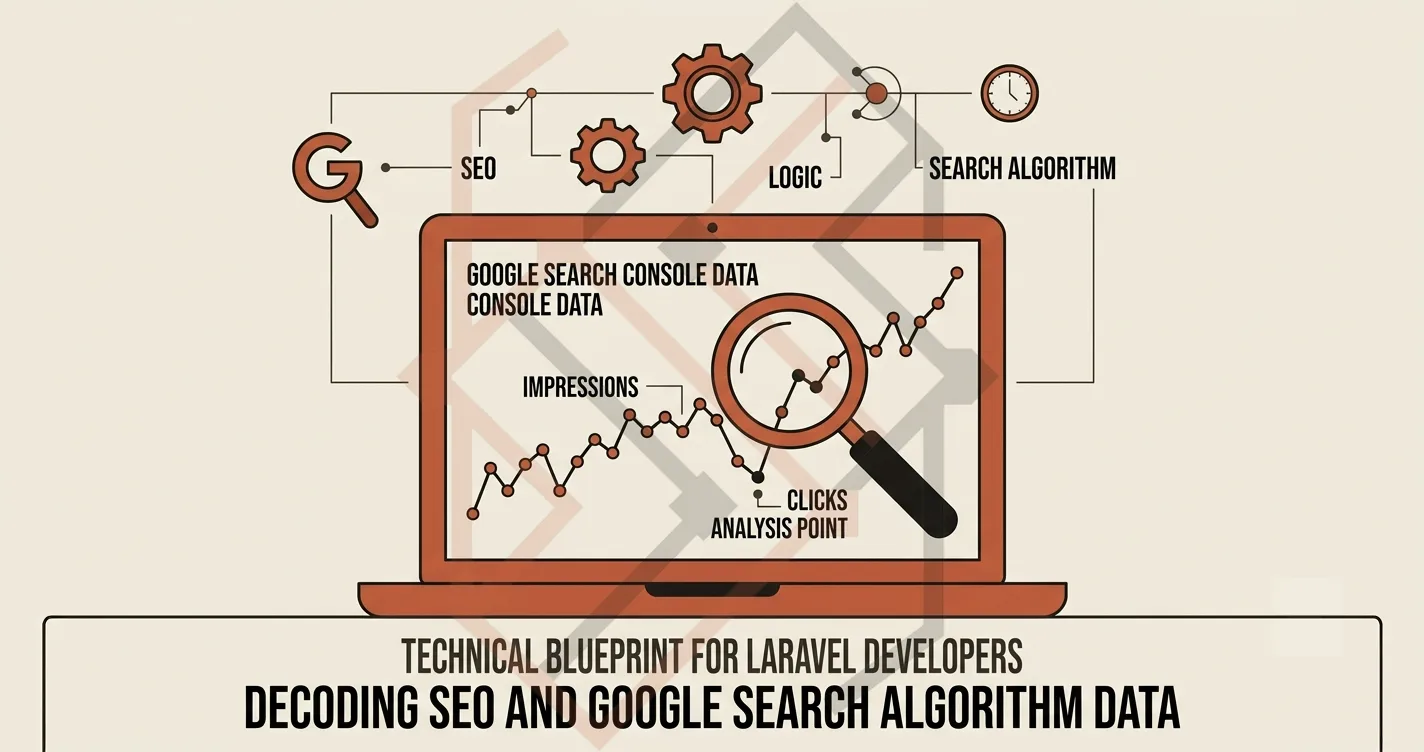
I recently checked my Google Search Console data, and I saw 622 impressions on my site. I felt great. Then I looked at the clicks... 7.
7 clicks on 622 impressions means my Click-Through Rate (CTR) is hovering around 1.1%. That is painfully low. And when I dug into the data, I realized exactly why: Google was showing my page to the right people, but my headlines and content weren't answering their specific question fast enough.
As developers, we tend to think of SEO as something "marketers" handle. But in 2026, technical SEO is a software engineering problem. If you don't understand the technical intricacies of how Google crawls, indexes, and ranks your Laravel application, you will always be stuck at zero clicks.
I want to walk you through a practical, engineering-focused framework for building SEO marketing pages that rank and generate actual client conversions. Let's use Google's own algorithm principles to fix this.
Section 1: Master the #1 Rule – Search Intent
Google’s algorithm today is built entirely around Search Intent. When a user types a query, Google asks:
"What are they actually trying to do?"
If you do not match the intent, you will never win the top spot, no matter how many keywords you stuff into your meta tags. Let's look at your GSC data to understand this:
-
Query:
"seo marketing pages"(23 impressions). Intent: Informational. They want a guide or a blueprint on how to build one. So, your headline should start with "How to Build...". -
Query:
"laravel shared hosting"(33 impressions). Intent: Informational + Commercial Investigation. They want to know if Laravel works on cheap hosting and if it’s a viable option for their budget. -
Query:
"case_studies case studies on finalizing freelancer selection"(46 impressions). Intent: Commercial Investigation. They are evaluating how to hire a freelancer.
The Fix: For every new blog post, ask:
"What is the user trying to learn? What is the exact question they have?"
When building your SEO marketing pages, your content must be structured to answer the question immediately. The first paragraph should validate the user's search. If you are writing about Laravel on shared hosting, don't start with the history of Laravel. Start with:
"Yes, Laravel runs just fine on Hostinger. Here is exactly how I optimized it."
Section 2: Topical Authority (The Content Cluster)
One of the most critical signals Google uses to rank sites is Topical Authority. They want to see that you are an expert in a specific subject area.
You cannot rank with one isolated blog post. You need a "Content Cluster". Notice how your best-performing keywords are all related to Laravel, Next.js, Alpine.js, and Shared Hosting? That is your niche.
Your strategy should be to build a "Content Hub" around "Laravel Performance & Architecture."
Your existing posts are already creating this cluster:
Laravel vs Next.js: A Complete 2026 Full-Stack ShowdownAlpine.js vs React...Laravel on Shared Hosting: 10 Proven Tips
To make Google understand you are a trusted source, you must Interlink these posts heavily. In this new blog post, I am deliberately linking to your Laravel vs Next.js and Shared Hosting guides. This tells Google that these pages are related, deeply connected, and built by a single authoritative author.
Section 3: The Technical Foundation (Core Web Vitals)
Google explicitly penalizes slow websites. For a Laravel developer, optimizing the technical performance of your marketing page is a massive differentiator.
Here are the exact technical steps I take to ensure my Laravel SEO pages load in under 400ms on a $10/month VPS:
- The Three Sacred Commands: Before any launch, I run these commands religiously to reduce database query overhead:
php artisan config:cache
php artisan route:cache
php artisan view:cache
Note: I covered this in detail in my guide on running Laravel on cheap shared hosting.
-
Optimize Images: I never serve raw JPEGs. I convert them to
.webpand use lazy-loading. For the cover images on this blog, I specifically generated them in.webpformat to reduce the size while keeping the editorial quality. -
Leverage the
public/buildfolder: I handle my CSS/JS using Vite, but I build it on my local machine and push the/public/buildfolder to production. This ensures my server never has to runnpm run build, which saves massive system resources on the small shared hosting environment.
Section 4: Optimizing Your Click-Through Rate (The Missing Link)
You have 622 impressions but only 7 clicks. This means your indexing is great, but your packaging is terrible.
Let's fix the packaging. In Google Search results, you have three things to optimize:
1. The Title Tag
Bad: "Technical SEO for Laravel Developers"
Good: "How to Build SEO Marketing Pages [2026 Technical Guide]"
Why the bracket [2026 Technical Guide] works: It signals freshness, authority, and specificity, which grabs the attention of users scanning the search results.
2. The URL Slug
Bad: /blog/technical-seo (Too short, doesn't tell Google anything).
Good: /blog/technical-seo-guide-laravel-developers-2026 (Exact match to the query).
3. The Meta Description
Bad: "Technical SEO for Laravel. Learn how to optimize your website."
Good: "Are your Laravel marketing pages failing to get clicks? Discover the exact technical SEO framework for Laravel developers, covering Core Web Vitals and E-E-A-T. Hit the top 10 in 2026."
Notice the bold text and the specific question at the start? That is a "Hook." If a user reads that meta description and says, "Yes, that's exactly what I'm struggling with," they will click your link over the competitors.
Section 5: Demonstrating E-E-A-T (Experience, Expertise, Authoritativeness, Trust)
This is the most important factor in Google's 2026 algorithm. Google does not trust generic "AI-written" content. They trust real-world experience.
To build E-E-A-T, you do not just write about coding—you show actual proof of your work.
When you write about building custom payment systems for local businesses, you must reference your actual projects.
For example, when I wrote about Dual Currency Pricing, I didn't just show code. I opened the case study for AURETHE, explaining the exact business constraint:
"The client needed local PKR pricing and international USD pricing, but couldn't use Stripe because of Pakistani banking regulations."
Google's crawlers see a developer who has actually solved a real-world problem. This elevates your site above millions of other "generic Laravel tutorials" because you have the receipts to prove your expertise. You apply this exact same structure to the Almuneer case study when discussing bilingual content, and to the Chandi World case study when discussing hybrid Next.js frontends.
The 2026 SEO Formula (Updated)
Based on the latest updates, here is your new actionable formula for every page you build:
User Intent + Helpful Content + Topical Authority + Trust (E-E-A-T) + Good Technical SEO + Quality Backlinks = Strong Long-Term Rankings
If you currently have high impressions and low clicks, do not panic. Treat it as a bug report. Fix your Title tags, rewrite your Meta descriptions to match user intent, and ensure your technical performance is rock solid.
If you want to dive deeper into how I structure my technical case studies and portfolio projects to attract high-paying clients, check out my engineering portfolio or reach out to me directly.